GY
Rotary Feeders
Discover UHM’s Rotary Feeders. Enclosed Powder Conveying and Process Environment Isolation
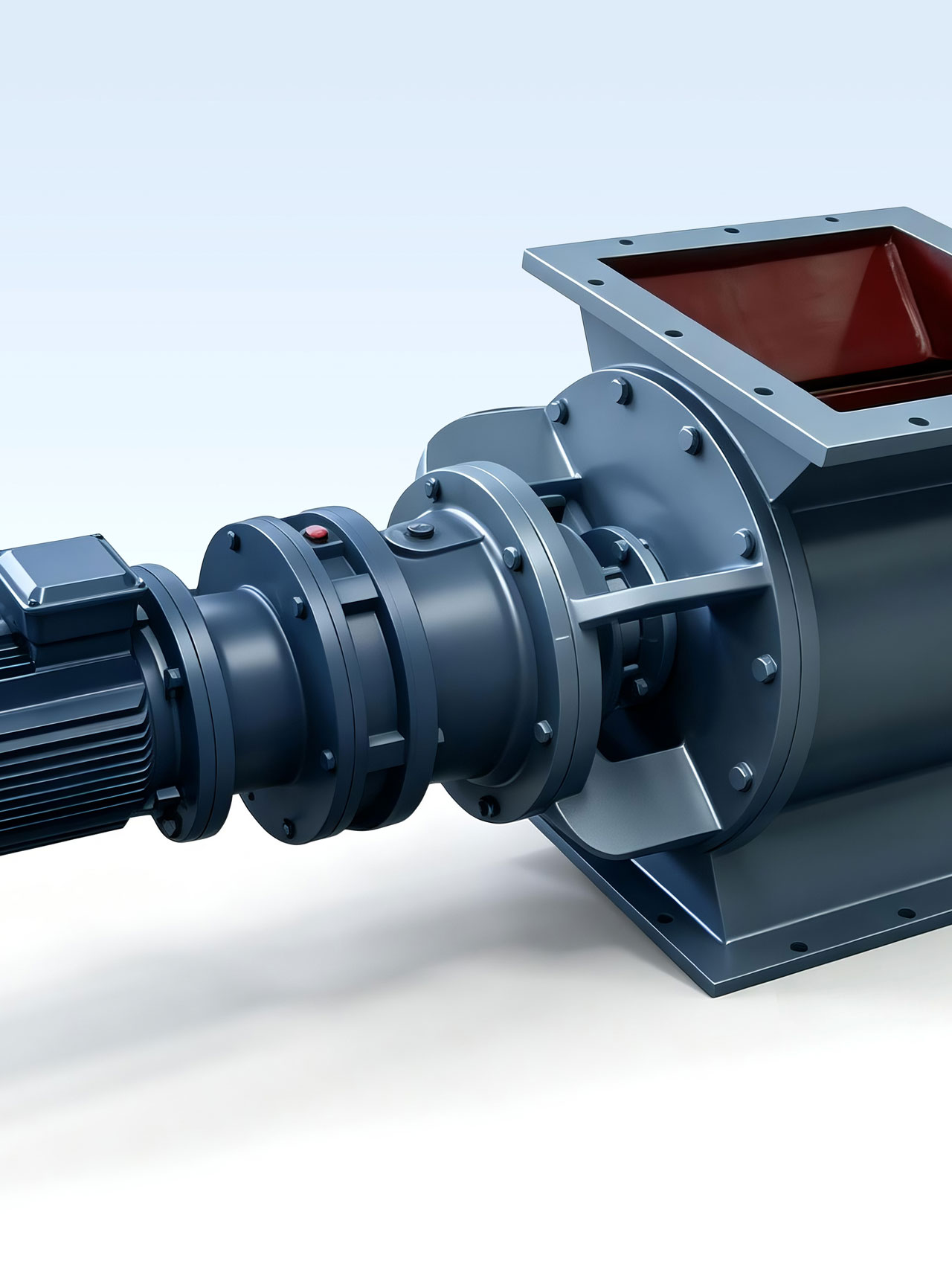
High-Seal Lock-Air Valve Hub Engineered for Ultra-Fine Powders
GY Rotary Feeders
Continuous, Uniform, and Quantitative Feeding of Dry Powders and Granules
The GY Type Rotary Feeder (commonly referred to as a star discharger or rotary valve) is a premium process control apparatus custom-engineered by UHM, drawing on advanced pneumatic conveying and bulk solids handling expertise. It handles dry powders and small granular materials with absolute uniformity, continuity, and quantitative accuracy.
Zero-Transmission-Loss Rigid Direct-Coupled Architecture
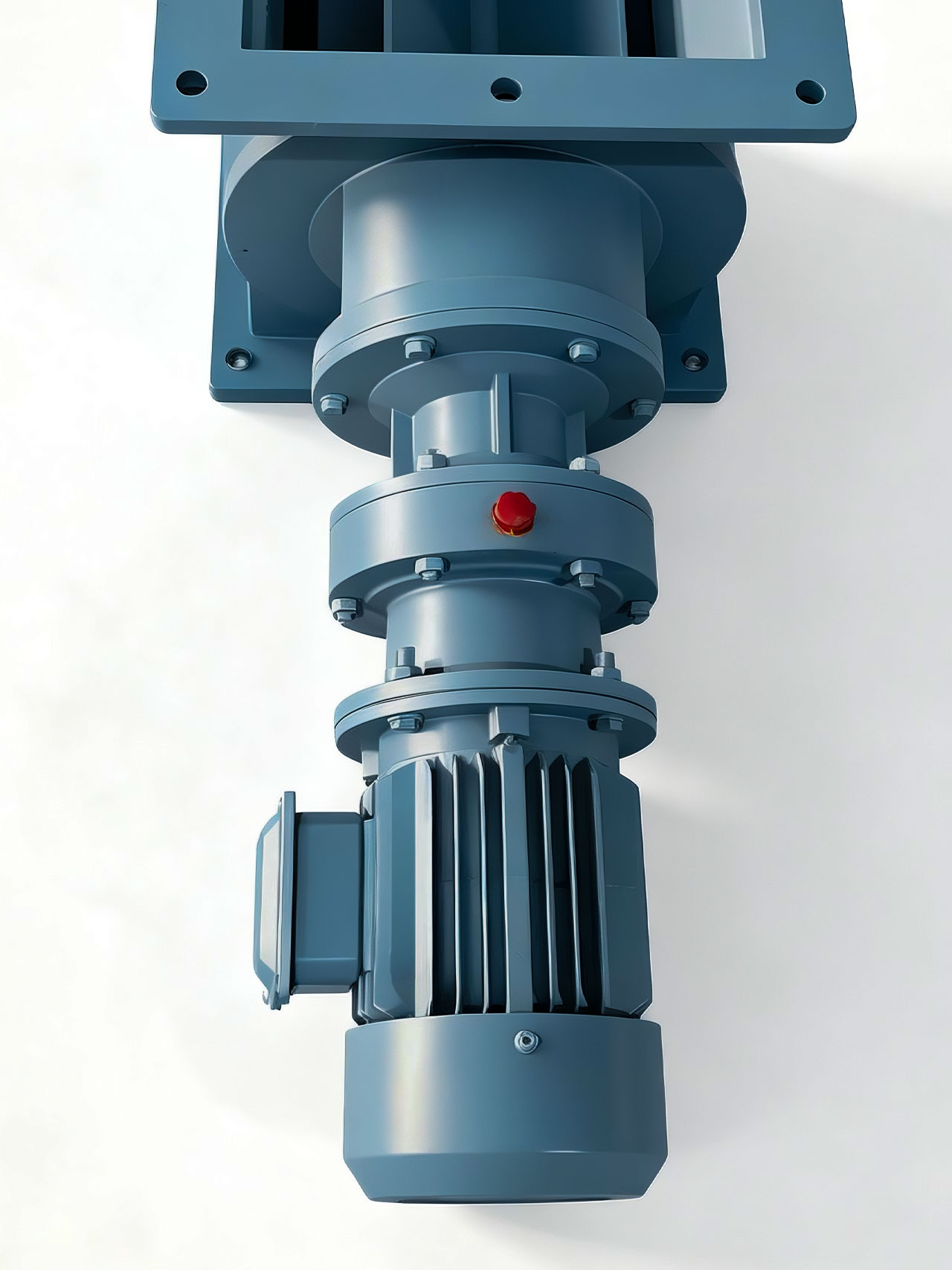
Structurally, the GY series showcases exceptional compactness and industrial durability. The complete assembly consists of a rigid cylindrical housing, a multi-vane rotor, heavy-wear seals, and a high-grade cycloidal pinwheel speed-reducing motor. This series of rotary feeders eliminates conventional chain or belt indirect drives in favor of a low-loss configuration where the reducer’s output shaft connects directly and rigidly to the main drive shaft, mitigating any risk of drive slippage or mechanical vibration.
Outstanding Technical Adaptability for Industrial Process Lines
Serving as an essential isolation barrier within pneumatic conveying, gravity receiving, and dust-collection loops, this rotary feeder is typically installed beneath pressurized hoppers, dust collector hoppers, or storage silo discharge gates. Across heavy-duty feeding layouts in cement, building materials, chemicals, metallurgy, light manufacturing, and grain processing, its capacity to withstand high differential lock-air pressures secures excellent process synergy. It is straightforward to install and maintain, effectively eliminating common bulk handling issues such as material flushing, core flooding, or severe fugitive dust emissions during process transitions.
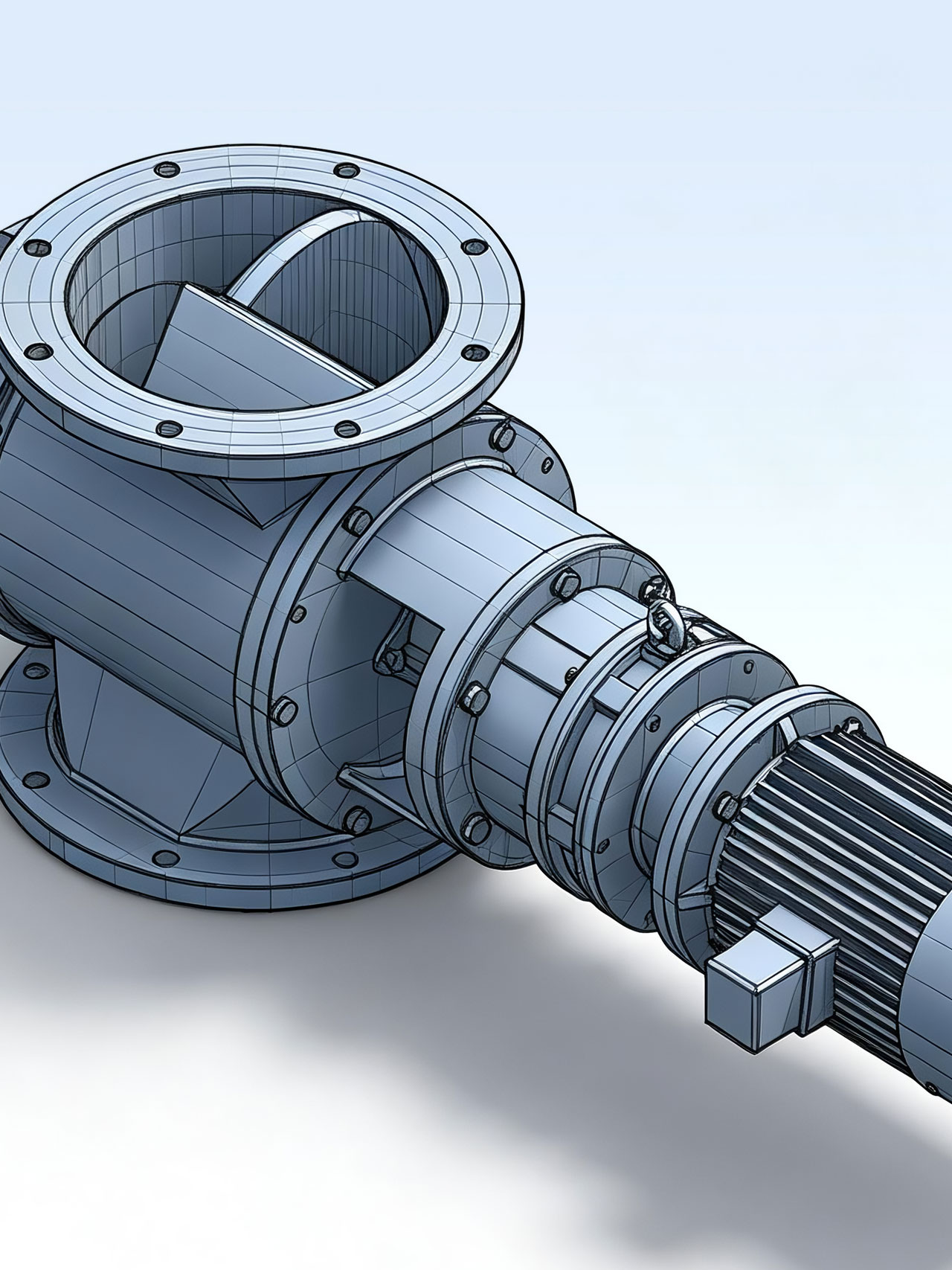
How Does It Work?
Main Shaft Rigid Volumetric Rotation Mechanism
The operational core of the GY rotary feeder relies on highly precise volumetric mechanical displacement logic. Power is supplied by the integrated BLY series rigid cycloidal gear motor, whose output shaft is rigidly locked to the rotating main shaft with zero clearance. When energized, the motor drives the shaft and rotor to rotate at a constant speed inside the closed cylindrical housing. A series of fixed rotor vanes are arranged symmetrically along the shaft, forming multiple independent V-shaped pockets of identical volume between the vanes and the curved housing wall. Bulk solids drop by gravity from the upper silo into these rotating pockets via the rectangular or inlet flange. As the rotor turns uniformly, the trapped material is mechanically transferred to the bottom discharge outlet and continuously fed into downstream systems.
Tight-Fit Housing Interfaces for Zero-Air-Leakage Isolation
To transfer materials while simultaneously cutting off the air pressure differential between the upstream and downstream zones (preventing gas blow-by), the tip and sides of every rotor vane are fitted with specialized rubber sealing strips. These strips are secured firmly using heavy-duty pressure plates and high-tensile bolts. During rotation, these flexible sealing strips maintain a continuous, tight-friction contact boundary against the interior walls and end covers, creating a high-damping dynamic seal. When the upper inlet operates under positive static pressure or the lower discharge faces pneumatic negative pressure, this barrier blocks counter-current airflow, maintaining excellent lock-air functionality while delivering a steady volumetric feed.
What Are Its Uses?
Building Materials & Cement: Anti-Flushing Control for Highly Fluidized Raw Meals and Fly Ash
In cement kiln batching circuits, silo-bottom bulk loaders, and fly ash collection loops, ultra-fine powders often become aerated inside storage bins, behaving like low-viscosity liquids (a phenomenon known as material flushing). Standard open feeders cannot contain this fluid-like flow, leading to material flooding. The rigid pocketed rotor of the GY series rotary feeder acts as a dynamic mechanical gatekeeper, restricting fluid powders within fixed-volume pockets to discharge them layer by layer, eliminating uncontrolled material rushes and stabilizing downstream weigh-feeding balances.
Pneumatic Conveying & Chemicals: Counter-Current Gas Barriers for Cross-Workshop Material Transfers
In fine chemicals, plastics injection, and synthetic resin processing lines that utilize positive or negative pressure pneumatic conveying lines, high-pressure air can easily blow backward into upper storage hoppers if isolation fails. This pressure loss destabilizes the conveying line velocity and causes intense dust emissions within the plant. The GY series utilizes the tight interface between its rubber seals and the housing shell to feed pellets or powders into the air stream while blocking high-pressure gas from escaping upward, securing the pressure balance of the pneumatic loop.
Power, Smelting, & Environmental Protection: Continuous Ash Discharge for Baghouses and Cyclones
Within steel smelting gas purifiers, coal-fired boiler flue gas scrubbers, and industrial dust-collection systems, the collection hoppers beneath baghouses and cyclone separators frequently operate under severe negative pressure. Any air leakage at the discharge gate draws ambient air into the collector, drastically reducing dust collection efficiency, causing condensation and filter bag blinding due to moisture mixing with hot flue gas, and increasing the risk of dust explosions. The GY series provides continuous automated ash discharging while serving as a dependable negative-pressure lock-air valve, keeping out ambient air to protect the processing safety and structural life of the filtration plant.
FAQ & VOTERS
What are the fundamental differences in material handling and process positioning between the GY rotary feeder and the GZD/ZSW series linear feeders?
They represent a complete division of labor between handling coarse run-of-mine lumps and micro-fine powders. The [ZSW Series Heavy-Duty Grizzly Feeder] and [GZD Series Vibrating Feeder] are powerful vibrating units engineered to absorb the impact of giant rocks dropped from dump trucks while using grizzly bars to scalpe out soil; because they are open systems, they offer zero air-sealing capability. Conversely, the GY Rotary Feeder is a fully enclosed, volumetric pocket-rotor machine designed exclusively for dry powders, micro-fines, or tiny granules under a few millimeters (such as cement, flour, or chemical powders). The GY model possesses no structural resistance against heavy impact loading, but it delivers the essential lock-air pressure isolation and anti-flushing control that vibrating machines cannot provide.
Do the standard rubber sealing strips on the GY series wear out quickly, and how should they be maintained when handling slightly abrasive or warm materials?
Because the rubber strips must maintain a tight-friction contact against the interior housing wall to secure high lock-air efficiency, they are normal process wear items. Prolonged friction when handling abrasive mineral powders or chemical reagents will gradually wear down the edges, increasing the clearance gap and leading to air leaks. To resolve this, UHM integrates a bolt-fastened, adjustable pressure plate assembly. Maintenance teams can easily adjust the strips forward to compensate for wear or replace them by opening the side inspection covers without dismantling the entire housing from the pipeline. For higher temperature streams, specialized materials such as Viton, polyurethane, or alloy wiper plates can be customized to restore the factory-spec seal.
Why shouldn’t process engineers rely solely on the nominal capacities listed in the technical data sheets during equipment selection?
The rated capacities across our technical tables—ranging from 7 m3/h for the compact GY-200×200 up to 106 $m^3/h$ for the heavy-duty GY-500×500—are calibrated under ideal conditions assuming a 100% volumetric pocket filling efficiency at a fixed rotor speed of 34 r/min. In true industrial installations, the real throughput is limited by material flow characteristics and system differential pressures. For example, sticky or cohesive chemical powders slow down during pocket entry and discharge, dropping the real filling efficiency to 60%–70%. Concurrently, high differential pressure causes tiny amounts of counter-current air leakage that can slow the descent of fine powders. Therefore, actual system designs must apply an empirical reduction coefficient based on material viscosity, bulk density, friction angles, and differential pressures to ensure consistent downstream delivery.