High-Efficiency
TD/TH/NE Type
Bucket Elevators
Discover UHM’s TD/TH/NE Type Bucket Elevators. Vertical Bulk Stream Transport Hub Bridging Lightweight Velocity and Severe Abrasive Handling
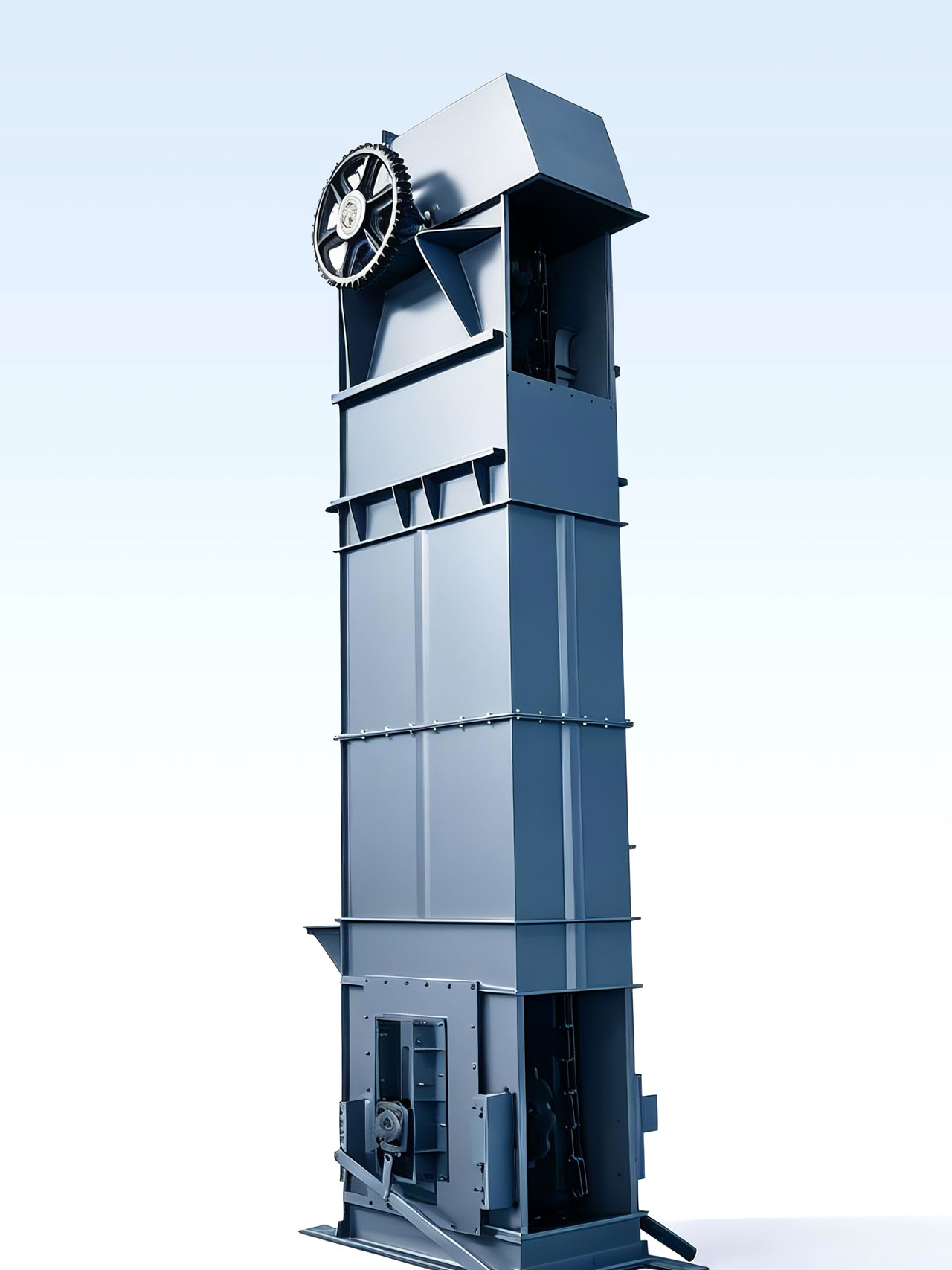
Dual-Purpose Feeder Excelled in Heavy-Duty Extraction and Mechatronic Batching
TD/TH/NE Type Bucket Elevators
Vertical Three-Dimensional Transport Balancing Light Bulk Solids and Highly Abrasive Fractured Ores
The Bucket Elevator (commonly abbreviated as a bucket lift) is a high-performance continuous vertical conveying apparatus engineered by UHM to solve cross-floor vertical hauling of solid bulk materials in modern processing plants. Operating in strict conformity with national engineering standards, the equipment utilizes a continuous array of buckets moving along a strictly vertical path within a fully enclosed steel casing, lifting materials from low-level boot pits to tower-top silo inlets at heights up to 40 meters. This comprehensive product line features the three most essential branches of contemporary industrial processing lines: the lightweight and high-elasticity TD Belt Type, the versatile and heat-resistant TH Round Chain Type, and the heavy-duty NE Plate Chain Type. Together, they seamlessly support operations ranging from a few cubic meters per hour of precise micro-component dosing to massive capacities of 800 cubic meters per hour for blast furnace charging circuits.
Traction Component Characteristics and Extreme Temperature Adaptability Across Three Configurations
- TD Type Belt Bucket Elevator: Utilizes a high-tensile, high-elasticity rubber belt as its traction component, ensuring remarkably smooth operation with minimal noise. The standard rubber belt is optimized for material temperatures up to 60℃. When configured with a premium heat-resistant rubber belt, its thermal operating boundary extends up to 200℃, making it ideal for the vertical transfer of non-abrasive or semi-abrasive lightweight powders and granules with bulk densities under 1.5t/m3.
- TH Type Round Chain Bucket Elevator: Upgraded with high-strength alloy steel forged round link chains as traction elements, providing profound tensile integrity and native resistance to thermal stress degradation. The allowable temperature boundary for handled materials jumps directly up to 250℃.
- NE Type Plate Chain Bucket Elevator: Stands as the heavy-duty standard for modern heavy industries. Its traction element features large-pin specialized steel plate chains, delivering unparalleled shear strength, fatigue resistance, and an extended wear life. Utilizing large-capacity buckets arranged at tight, dense pitches, it vertically hoists highly abrasive, large-lump heavy mineral materials such as raw meals, cement clinker, run-of-mine coal, limestone, and calcined materials (with the heavy NE800 delivering capacities up to 800 m3/h).
Floating Shaft-Mounted Drives and Diversified Bucket Gradation Selections
At the drive and execution layers, multiple mechanical optimizations have been integrated:
- TD Type Shaft-Mounted Drive: Features an advanced YZ series shaft-mounted gear reducer fitted directly onto the head shaft journal. This configuration completely eliminates traditional heavy-gauge drive platforms and flexible couplings, creating a highly compact head section. The reducer floats in unison with the main shaft to eliminate structural installation stresses and integrates an engineered roller backstop for absolute anti-reversal safety.
- Multi-Geometry Bucket Configurations: To match varying material flow characteristics, the TD/TH series offers four specialized bucket variants: Q-type (shallow bucket for damp, cohesive powders), H-type (arc-bottom bucket), Zd-type (medium-deep bucket), and Sd-type (deep bucket for dry, fluid granules prone to shifting), providing accurate volumetric capacity tailoring for field conditions.
During equipment selection, engineers must note that while the TD and TH series operate at higher linear speeds, their structural mechanics restrict them exclusively to loose bulk solids with bulk densities of ρ<1.5 t/m3 and small particle sizes. If your process requires lifting high-density materials with severe abrasiveness or sharp, cutting edges—such as large-lump limestone, clinker, or iron ore (with particle sizes > 40 mm and up to 140 mm)—the high-strength steel plate-chain NE Series must be selected.
⚙️ PROCESS NOTE: During equipment selection, engineers must note that while the TD and TH series operate at higher linear speeds, their structural mechanics restrict them exclusively to loose bulk solids with bulk densities of ρ<1.5 t/m3 and small particle sizes. If your process requires lifting high-density materials with severe abrasiveness or sharp, cutting edges—such as large-lump limestone, clinker, or iron ore (with particle sizes > 40 mm and up to 140 mm)—the high-strength steel plate-chain NE Series must be selected.
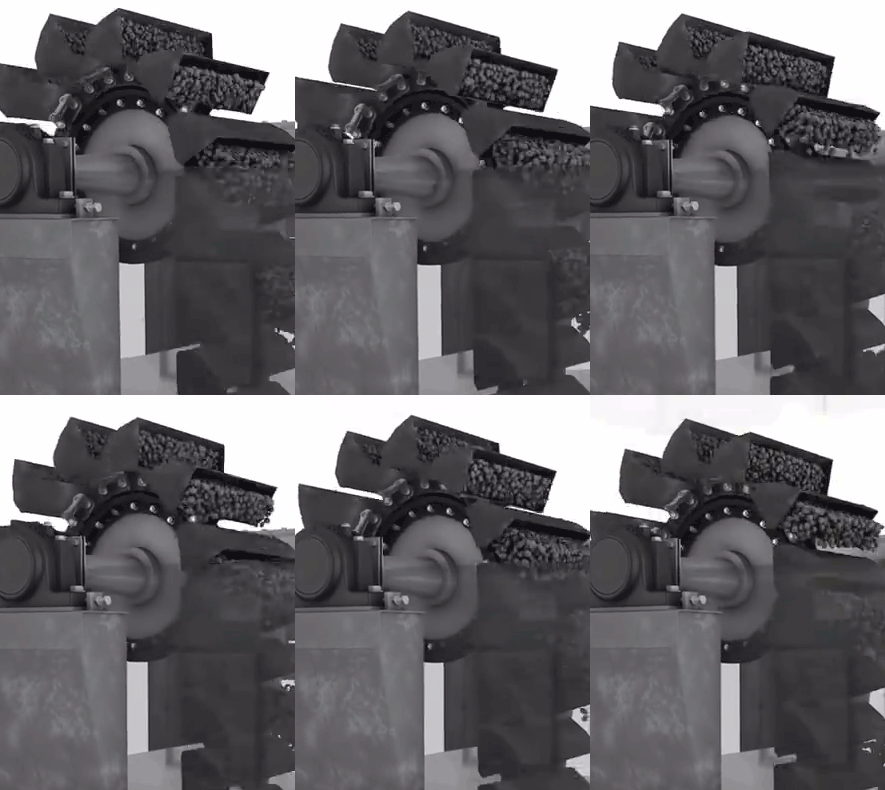
How Does It Work?
Digging-Type and Inflow-Type Composite Loading Dynamics at the Boot Section
The method of loading bulk solids at the bottom boot section directly dictates the equipment’s running resistance and particle degradation rates:
- Digging-Type Loading (Standard on TD/TH): Bulk materials enter through the inlet chute and collect directly on the curved bottom plate of the lower boot housing. The high-speed moving buckets (with belt velocities ranging from 1.4 ~ 2.0 m/s) forcibly scoop up materials directly from the pile as they sweep through the lower center dead center. This method ensures excellent bucket filling efficiency and high-speed operation, making it ideal for non-abrasive, light powders and granules.
- Inflow-Type Loading (Standard on NE Plate Chain): Material flows continuously directly from an elevated inlet chute into every single large-capacity bucket as they pass the loading zone. Because the buckets are arranged tightly with virtually no gaps and move at a low, stable linear chain speed (typically around 0.5 m/s), they do not strike a pile of abrasive minerals at the bottom. This layout eliminates scooping impacts and running resistance from the source, lowering required motor power and preventing large minerals from jamming or crushing in the boot section.
Centrifugal Flinging and Induced Gravity Discharge Dynamics at the Head Section
When the buckets reach the top drive sprocket or pulley of the head section, they undergo a spatial inversion, causing the material to discharge under distinct mechanical principles:
Centrifugal and Mixed Discharge (TD/TH Series): Driven by high linear speeds (1.4 ~ 2.0 m/s), the centrifugal force acting on the materials as they clear the crest of the head pulley exceeds gravitational force. Before the bucket flips completely upside down, the bulk solids are flung outward along a tangential trajectory, landing against the discharge strike plates of the head hood and sliding smoothly into the discharge spout.
Induced Gravity Discharge (NE Series): Because the plate chain operates at a low linear velocity (≈ 0.5 m/s), minimal centrifugal force is generated as the buckets round the drive sprocket. The material relies entirely on gravity to slide out. As a bucket tips forward, the backside of the preceding bucket forms a long, angled chute. The discharging solids slide naturally and smoothly down this guiding back plate into the discharge throat. This method provides a gentle cushioning effect for large, abrasive lumps, preventing high-velocity impacts against the head hood and reducing particle degradation.
⚙️ PROCESS NOTE: Centrifugal discharge (TD/TH series) is highly sensitive to rotational speeds. Because the head pulley RPM and drum diameters (e.g., 48 to 67 r/min) are dynamically matched to specific kinematic equations, operators must never attempt to drastically alter the head shaft speed after installation via larger motor pulleys or excessive VFD adjustments. Dropping the speed below design parameters eliminates the required centrifugal force, causing material to drop backward down the return casing, resulting in heavy boot accumulation and immediate motor stalling.
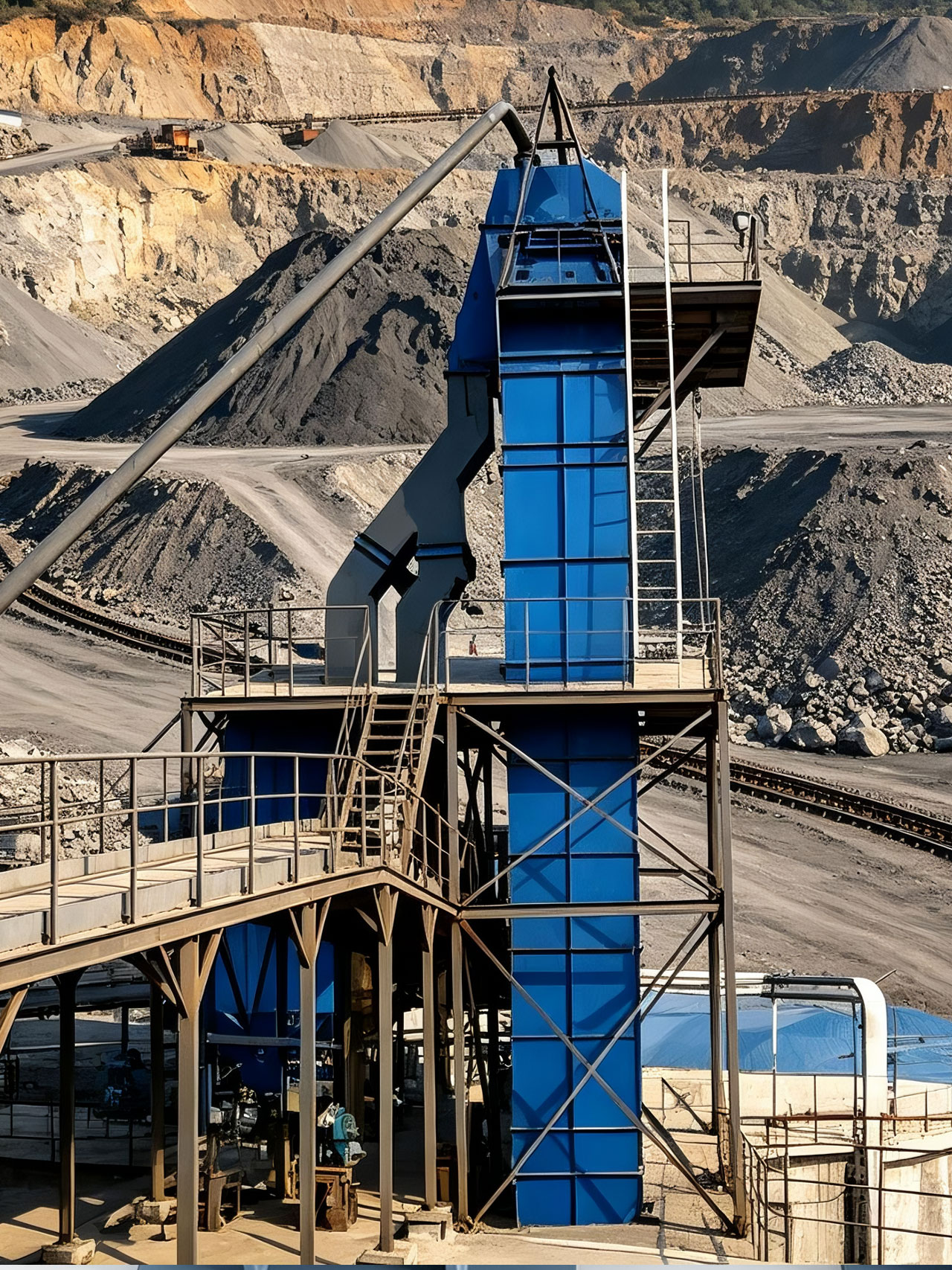
What Are Its Uses?
Building Materials, Bulk Cement, & Flue Dust Collection: High-Lift Vertical Elevation of Raw Meals and Dry Clays
In modern ready-mix concrete batch plants, cement mill homogenization silos, and dry-mix mortar processing lines, massive tonnages of powdery raw meals, finished cement, and dry clays must be continuously hoisted from ground level to storage tanks at heights of 20 to 30 meters. The TD series belt bucket elevator, with its rapid linear speeds and precise bucket options (such as the Zd or Sd deep bucket configurations), delivers a high volumetric material stream for continuous processes. Concurrently, the TH series round chain elevator easily handles the high temperatures of freshly discharged kiln clinkers, securing continuous, dust-free vertical silo charging.
Power Generation, Coal Washing, & Chemical Coking: Anti-Blinding Vertical Transfer of Raw Coals and Middlings
Within utility boiler coal-handling loops, coal washing facility transfer stations, and cross-floor carbon raw material lines in chemical plants, bulk solids often present high surface moisture levels due to seasonal weather changes. The NE series plate chain bucket elevator, leveraging its excellent structural shear strength and large-capacity buckets (with NE50 through NE600 covering massive lifting capacities from 60 ~ 600 m3/h), adapts perfectly to wet coals during rainy seasons (handling wet coal moisture levels up to 13%). Its low-speed gravity-induced discharge prevents moist fines from compacting inside the buckets, ensuring high operational availability for fuel feed loops.
Mining Beneficiation, Crushing Yards, & Aggregate Production: Heavy-Duty Shock-Resistant Elevation of Coarse Ores
In primary crushing loops and aggregate screening facilities, primary-crushed limestone and high-hardness clinker with chunk dimensions from 40 mm ~ 140 mm require closed-loop vertical recirculation back into sizing screens. The NE plate chain bucket elevator is equipped with specialized wear-resistant alloy pins and heavy-duty sidebars designed for high fatigue life. This structure handles oversized mineral chunks with ease, while its inflow-type loading pattern protects the buckets from heavy rock impacts at the bottom boot, delivering steady, high-tonnage heavy-duty elevation with minimal breakdown rates.
FAQ & VOTERS
During field operations, TD belt-type bucket elevators are occasionally prone to belt slippage or tracking deviations. What causes this, and how can it be corrected?
Belt slippage and tracking tracking deviations are the most common operational challenges encountered by belt-type elevators (such as the TD250 and TD400). Slippage occurs when belt tension drops below the threshold required to overcome the load, or when excessive feed forces immediate boot blinding; the head pulley then spins inside the rubber casing, leading to intense frictional heat and belt tracking damage. Tracking deviation (running off-center) stems from misaligned head/boot shaft parallelisms or an uneven belt splice joint. To correct these conditions, maintenance personnel must adjust the screw-type or gravity-take-up slide rails at the lower boot housing to square the bearings and restore proper belt tension.
What are the fundamental differences in wear rates, failure profiles, and maintenance overhead between TH round link chains and NE plate chains?
They represent two entirely different stages in chain design evolution. The TH series round link chain utilizes interlocking steel loops that maintain point-to-surface contact with the pocketed chain wheels on the head shaft; at high operating speeds, this generates localized impact noise (resembling a heavy chain rattling) and accelerates wear at the interlinked chain-loop contact points over extended duty cycles. Conversely, the NE series plate chain represents a rigid mechanical upgrade, utilizing a precision-machined pin-and-bush assembly where the chain links maintain line-to-surface engagement with the drive sprocket. Operating at a low speed of approximately 0.5 m/s, it runs with minimal noise. While the NE series carries a higher initial investment, its combination of inflow-type loading and low-speed gravity discharge yields a wear life and shear strength that far outlasts TH round links, drastically lowering breakdown rates on 24/7 continuous process lines.
If a plant’s throughput requirements increase, can engineers boost capacity by fabricating larger buckets or spacing the buckets closer together along the belt or chain?
Modifying bucket pitch or volume must always undergo a strict mechanical review of the entire system load limits; modifications should never be made arbitrarily in the field. On an NE series unit, for example, the bucket width (250 to 800 mm) and pitch (305 to 800 mm) are precisely balanced at the factory against the shear strength of the plate chain, the rated dynamic load capacity of the head bearings, and the matched motor power (kW). If you reduce the bucket spacing or weld on oversized extensions, the total mass of the material column hanging on the vertical track spikes exponentially. This will cause the main motor to trip frequently due to insufficient starting torque—potentially burning out the windings—and can push the plate chain past its ultimate tensile yield strength, triggering a catastrophic chain snap where the entire vertical bucket string crashes into the boot. If capacity adjustments are required, contact our engineering department to check the chain safety margins and calculate motor reserves for a certified upgrade path.