PZ/PDX
Reciprocating Feeders
Discover UHM’s PZ/PDX Type Rotary Pan Feeders. Dual-Purpose Feeder Excelled in Heavy-Duty Extraction and Mechatronic Batching
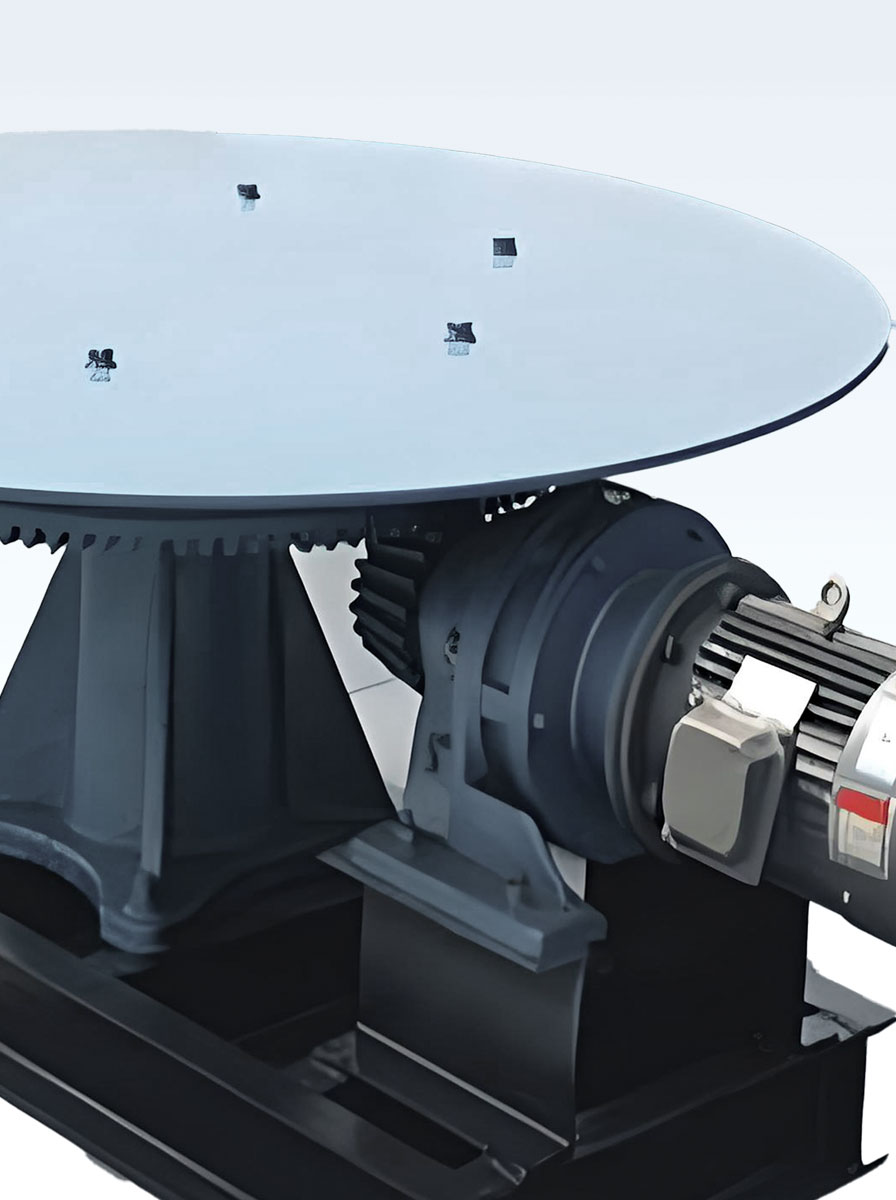
Dual-Purpose Feeder Excelled in Heavy-Duty Extraction and Mechatronic Batching
PZ/PDX Type Reciprocating Feeders
Continuous Volumetric Discharge and Silo Locking Functionality
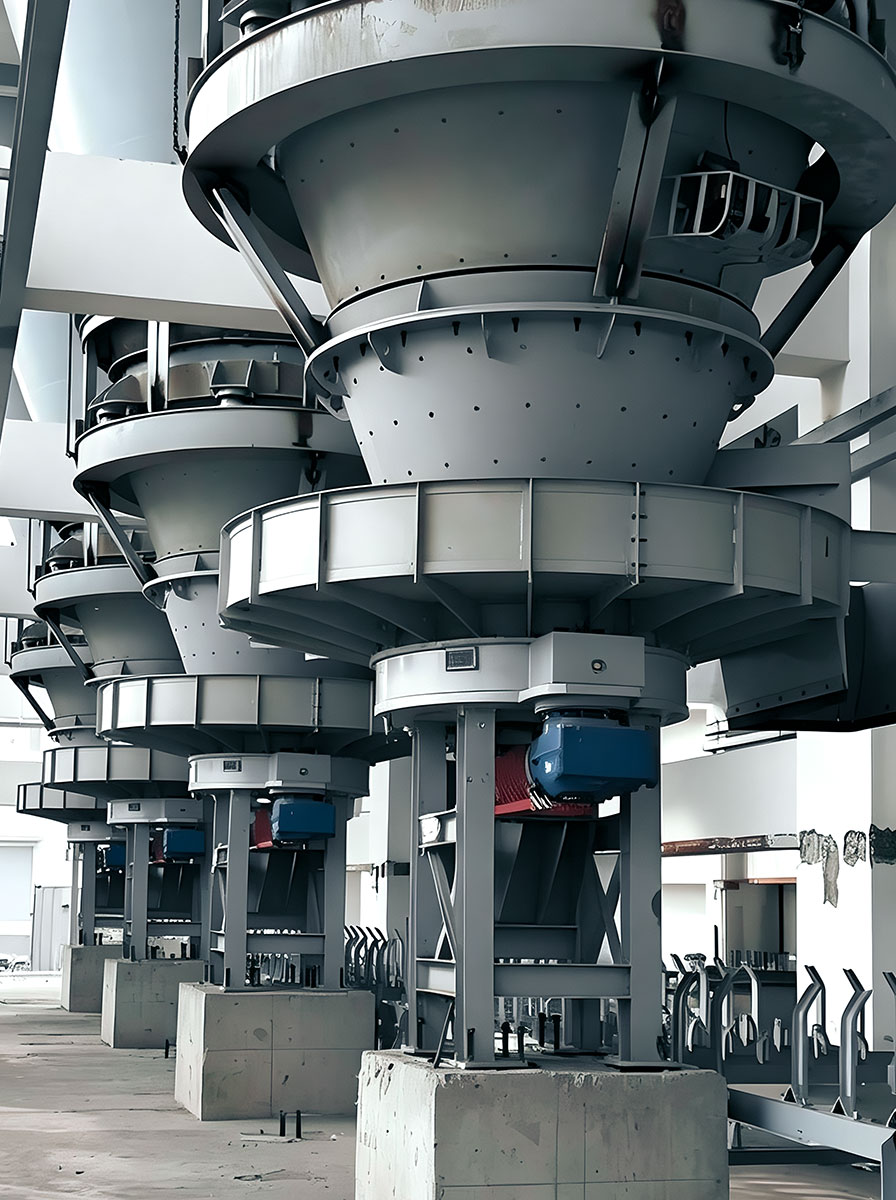
The Rotary Disc Feeder (commonly known as a rotary table feeder or circular disc feeder) is an advanced continuous volumetric feeding apparatus developed by UHM specifically for high-density, high-silo-pressure bulk solids. Installed directly beneath the discharge spouts of storage bins, silos, and hoppers, it extracts materials smoothly via gravity combined with the forced horizontal rotation of the disc mechanism. When the feeder stops, the material naturally settles on the disc surface according to its angle of repose, creating an immediate material self-lock that prevents uncontrolled gravity emptying. By minimizing particle degradation and material degradation during extraction, this equipment serves as a critical process control node across metallurgical blast furnaces, mineral processing plants, coal blending facilities, cement yards, and mechanized foundry workshops.
Heavy-Duty Stationary Configuration (PZ Type) vs. Integrated Mechatronic Balancing System (PDX Type)
To accommodate varying degrees of industrial automation and mechanical loads, UHM provides two distinct structural layouts:
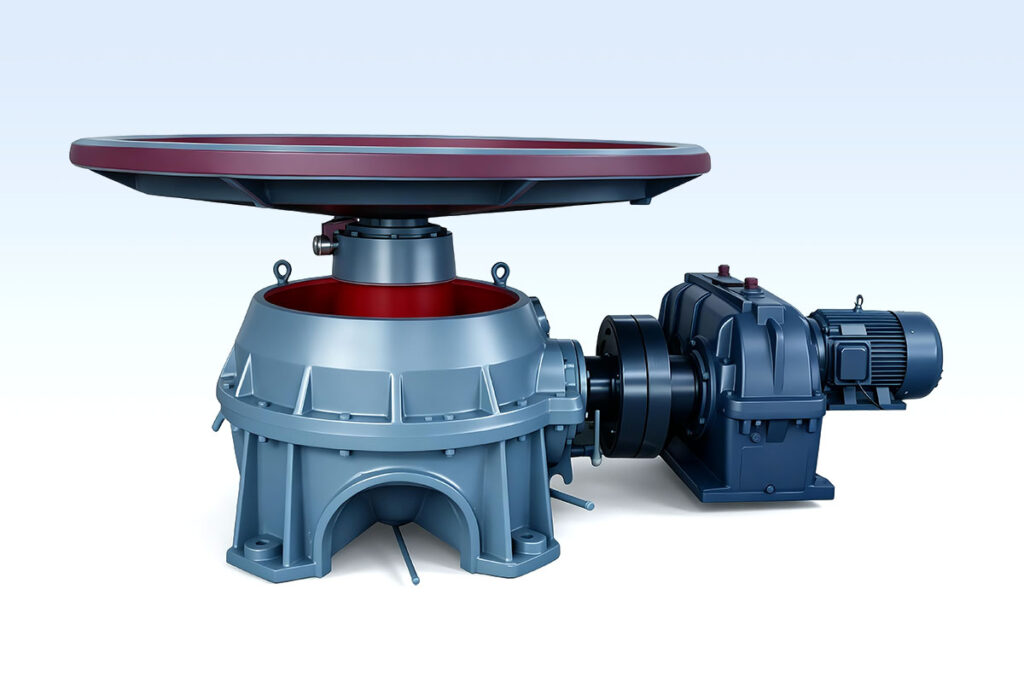
- PZ Series Heavy-Duty Table Feeder: A classic, robust mechanical configuration engineered primarily to continuously feed lump or granular materials with bulk densities up to 2500Kg/m3 (with the largest PZ31 processing maximum lump sizes up to 150mm. Featuring a standardized stationary layout, it boasts extreme climate resilience, operating reliably across ambient temperatures from -40℃ to +40℃.
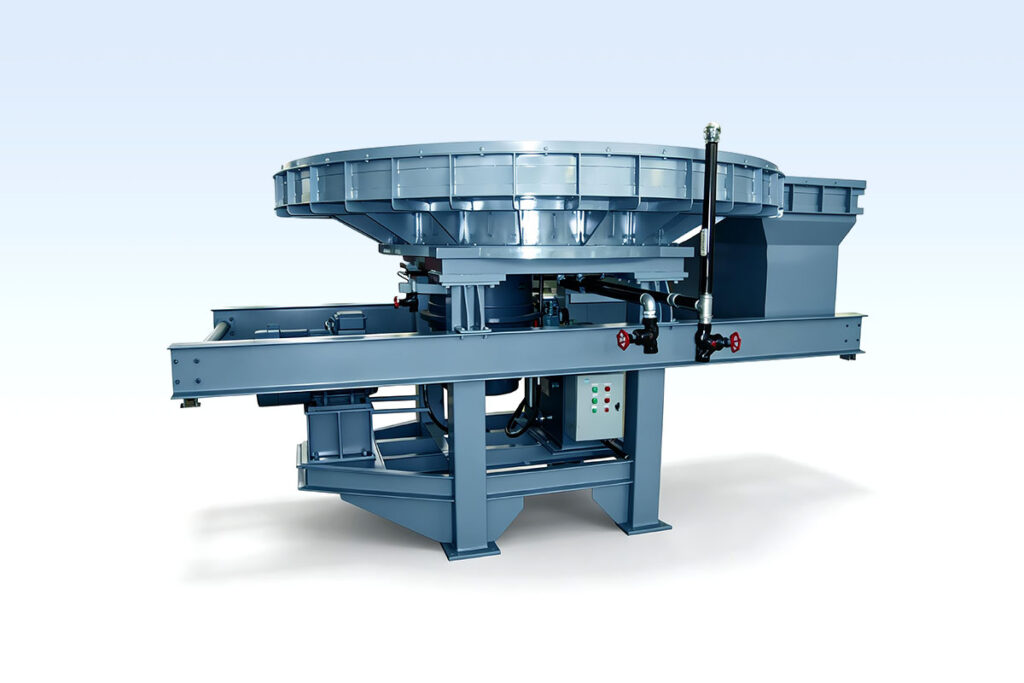
- PDX Series Mechatronic Quantitative Disc Feeder: A smart, automated batching system integrating the rotary disc feeder unit, a high-precision electronic weigh-belt scale (blending scale), and an intelligent instrument control panel. These elements run in dynamic synchronization to deliver high-precision, closed-loop continuous automated blending of bulk raw materials.
Advanced Hard-Faced Slewing Bearings and Enclosed Dust Containment
The PDX series incorporates multiple engineering upgrades that set new industry standards:
- High-Capacity Slewing Bearing: Moving away from standard center-shaft configurations, the PDX series utilizes a massive-diameter slewing bearing with hardened gear teeth. This structure handles immense vertical loads, easily withstanding continuous static pressures from material columns exceeding 15 meters for an operational life of over 10 years, while delivering high resistance to overturning moments and exceptionally low running resistance.
- Fully Enclosed Dust Containment: The system features an entirely enclosed layout, specifically utilizing a proprietary discharge sealing assembly beneath the disc. This configuration ensures that all extracted materials drop strictly into the discharge chute rather than spilling around the perimeter or accumulating inside the machine. Combined with a robust dust hood and standard extraction ports, it connects directly to plant dust-collection networks to eliminate fugitive dust emissions.
Rotary disc feeders are optimized for bulk solids with relatively stable physical properties. Because their operation relies on static material friction and mechanical plow shearing, this equipment is not recommended for handling materials with extremely poor flowability (e.g., sticky, high-moisture, or cohesive materials prone to blinding) or materials with extreme fluidization (e.g., completely aerated, bone-dry ultra-fine powders that flush easily).
⚙️ PROCESS NOTE: Rotary disc feeders are optimized for bulk solids with relatively stable physical properties. Because their operation relies on static material friction and mechanical plow shearing, this equipment is not recommended for handling materials with extremely poor flowability (e.g., sticky, high-moisture, or cohesive materials prone to blinding) or materials with extreme fluidization (e.g., completely aerated, bone-dry ultra-fine powders that flush easily).
How Does It Work?
Forced Volumetric Disc Rotation Mechanism
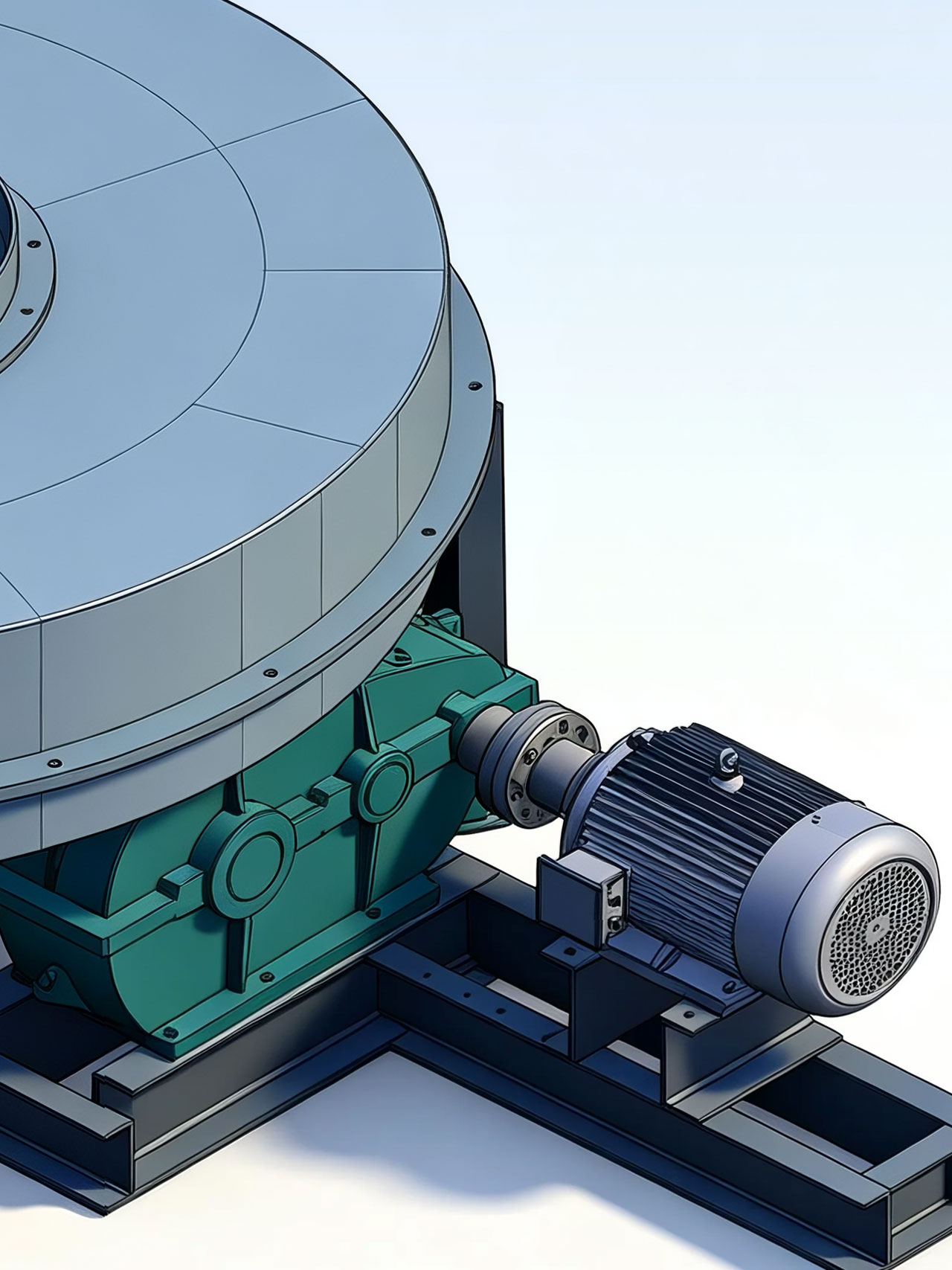
The operational kinetics of the rotary disc feeder are driven by a horizontal, low-speed volumetric rotation and mechanical plowing sequence. When the main motor (the electromagnetic speed-regulating YCT series for the PZ type, or a hard-faced gear motor paired with a variable frequency drive for the PDX type) is energized, power is transmitted via a heavy pinion to drive the external ring gear of the large-diameter slewing bearing. Since the slewing bearing is rigidly coupled to the horizontal table, the disc rotates uniformly beneath the hopper outlet at speeds typically ranging from 0.5 ~ 8 r/min. Bulk solids inside the silo drop by gravity through a non-clogging short sleeve onto the rotating disc surface, moving outward past the sleeve throat as a uniform material ring.
Adjustable Bed-Height Gate Control and Mechanical Scraper Discharge
To transform the rotating material ring on the disc into a steady downstream linear stream, the system coordinates multiple mechanical adjustment assemblies:
- Sectored Gate Adjustment: The initial height and cross-sectional area of the material ring on the disc are regulated by an adjustable bed-height control gate (sectored gate assembly) mounted on the short feed sleeve. Operators can easily set the baseline volumetric feed rate across a wide control range by modifying the gate opening.
- Plow-Scraper Mechanical Discharge: As the disc continues its rotation, the metered material ring hits a heavy-duty wear-resistant plow scraper positioned at a calibrated angle. The scraper acts as a stationary diverting dam, digging into the material layer to plow it continuously off the rotating disc surface. The plowed solids are guided by a discharge chute to drop cleanly and continuously into the downstream system, such as a weigh-belt scale.
For power transmission and mechanical efficiency, the PDX series exclusively utilizes hard-faced gear drives, delivering a transmission efficiency exceeding 90%. Compared to obsolete worm-gear disc feeders that suffer high frictional losses and peak efficiencies of only 60%, this hard-faced layout provides excellent energy savings, lower power consumption, and smooth, high-torque startups even under low-frequency, full-load, and high-silo-pressure conditions.
⚙️ PROCESS NOTE: For power transmission and mechanical efficiency, the PDX series exclusively utilizes hard-faced gear drives, delivering a transmission efficiency exceeding 90%. Compared to obsolete worm-gear disc feeders that suffer high frictional losses and peak efficiencies of only 60%, this hard-faced layout provides excellent energy savings, lower power consumption, and smooth, high-torque startups even under low-frequency, full-load, and high-silo-pressure conditions.
What Are Its Uses?
Iron & Steel Smelting: Precision Multi-Component Blending for Sintering and Blast Furnaces
In integrated steelmaking facilities, sintering plants, blast furnace ironmaking loops, and coking coal preparation lines, raw components like iron ore fines, manganese ores, coke breeze, and limestone must be continuously mixed according to strict stoichiometric ratios. PDX series variable-frequency quantitative disc feeders are typically installed in parallel matrices directly beneath massive storage bunkers. Because each disc easily withstands vertical material pressures from ore columns over 15 meters high, and its VFD utilizes advanced magnetic flux vector control (featuring an ultra-wide speed turn-down ratio of up to 1:25), the feeders deliver highly stable driving torque even at ultra-low speeds. Working alongside weigh-belt scales, they minimize blending deviations to ensure a highly stable blast furnace chemistry.
Building Materials & Cement: Stable Volumetric Feeding for Clinker, Gypsum, and Additives
In cement grinding circuits and dry mortar blending installations, raw components like large-lump gypsum and fly ash require highly reliable volumetric extraction. PZ and PDX rotary disc feeders process materials with lump sizes from 40 mm ~ 150 mm and high bulk densities up to 2.5 t/m3. All components in direct contact with materials—such as the short feed sleeve, the disc table, and the plow scraper—are fitted with high-strength wear-resistant liners to resist abrasive scoring from mineral grains, ensuring a uniform and uninterrupted supply of additive agents.
Power Plants & Chemical Process Loops: High-Capacity Fuel Transfer and Hopper Isolation
In utility boiler coal-blending circuits and high-density raw chemical material transfer hubs, the rotary disc feeder serves as both an accurate volumetric extractor and a dependable bunker isolation gate. If a downstream process encounters an emergency trip, the disc feeder stops instantly upon de-energization. The material resting on the disc table self-locks under its natural stack angle, resisting the high static pressure of the overhead bunker to prevent material flushing, flooding, and conveyor burying.
FAQ & VOTERS
How do the PZ/PDX rotary pan feeders compare against K type reciprocating coal feeders and GY rotary feeders regarding process application and material compatibility?
These three units focus on entirely different material control dynamics to cover distinct processing needs. The [K Type Reciprocating Coal Feeder] is a pure brute-force mechanical machine, using large-stroke linear plate displacement to shear out raw run-of-mine coal; it handles oversized or damp lump minerals easily but delivers a relatively coarse feed precision. The [GY Rotary Feeder (Rotary Valve)] is an air-tight, tight-clearance machine fitted with rubber edge seals, designed to meter micron-level dry powders while blocking differential air pressure; it cannot handle lump materials. The Rotary Pan Feeder balances heavy load capacity (exceeding rotary valves) with excellent continuous regulation accuracy (exceeding reciprocating feeders via VFD and scraper controls), making it ideal for processing mid-sized, non-cohesive granules (<150 mm) and high-density ores, especially in multi-unit automated quantitative blending matrices.
If the driving pinion, reducer, or large slewing bearing underneath the disc requires routine maintenance or a rebuild, must operators first drain the 15-meter-high ore silo?
No, this highlights the primary structural design advantage of the UHM PDX series—maintenance without silo draining. Traditional disc feeders deeply integrate their drive gears with the central disc shaft, meaning that any reducer failure or seal leak forces the plant to empty hundreds of tons of ore from the silo, remove the entire disc table, and then execute repairs, resulting in extended downtime. The PDX series resolves this by utilizing a modular design where the reducer and drive pinion are independent of the main disc assembly. During a drive tear-down, the short sleeve and the disc face remain supported by the heavy slewing bearing, which safely carries the static pressure of the overhead material column. Maintenance crews can safely unbolt and remove the drive motor and reducer from beneath the table without touching the material bed, shortening repair turnarounds.
The rated volumetric capacities for these machines are very broad (e.g., up to 300 m3/h for the PZ31 and 900 t/h for the PDX36). What field adjustments allow operators to fine-tune and dynamically control the exact discharge tonnage?
Plants can regulate discharge tonnage by combining “static” and “dynamic” control methods. The static method involves manually adjusting the bed-height control gate (sectored gate) before a production run. By raising or lowering the gate on the feed sleeve, operators change the cross-sectional area and thickness of the material ring on the disc. The dynamic method involves using a variable frequency drive (VFD) to adjust the disc’s rotational speed. The PDX series variable frequency package supports a wide $1:25$ turn-down range, allowing a 4-20mA automation signal from the central control room to adjust the disc speed seamlessly between 0.5 ~ 5 r/min. Increasing the rotation speed increases the volume of material plowed off by the scraper per unit of time, enabling rapid throughput adjustments and highly accurate gravimetric feeding when paired with a weigh-belt scale.