GD
Vibrating Hopper
An essential bin activation solution engineered to promote positive material flow and eliminate discharge issues for difficult-to-handle bulk solids.
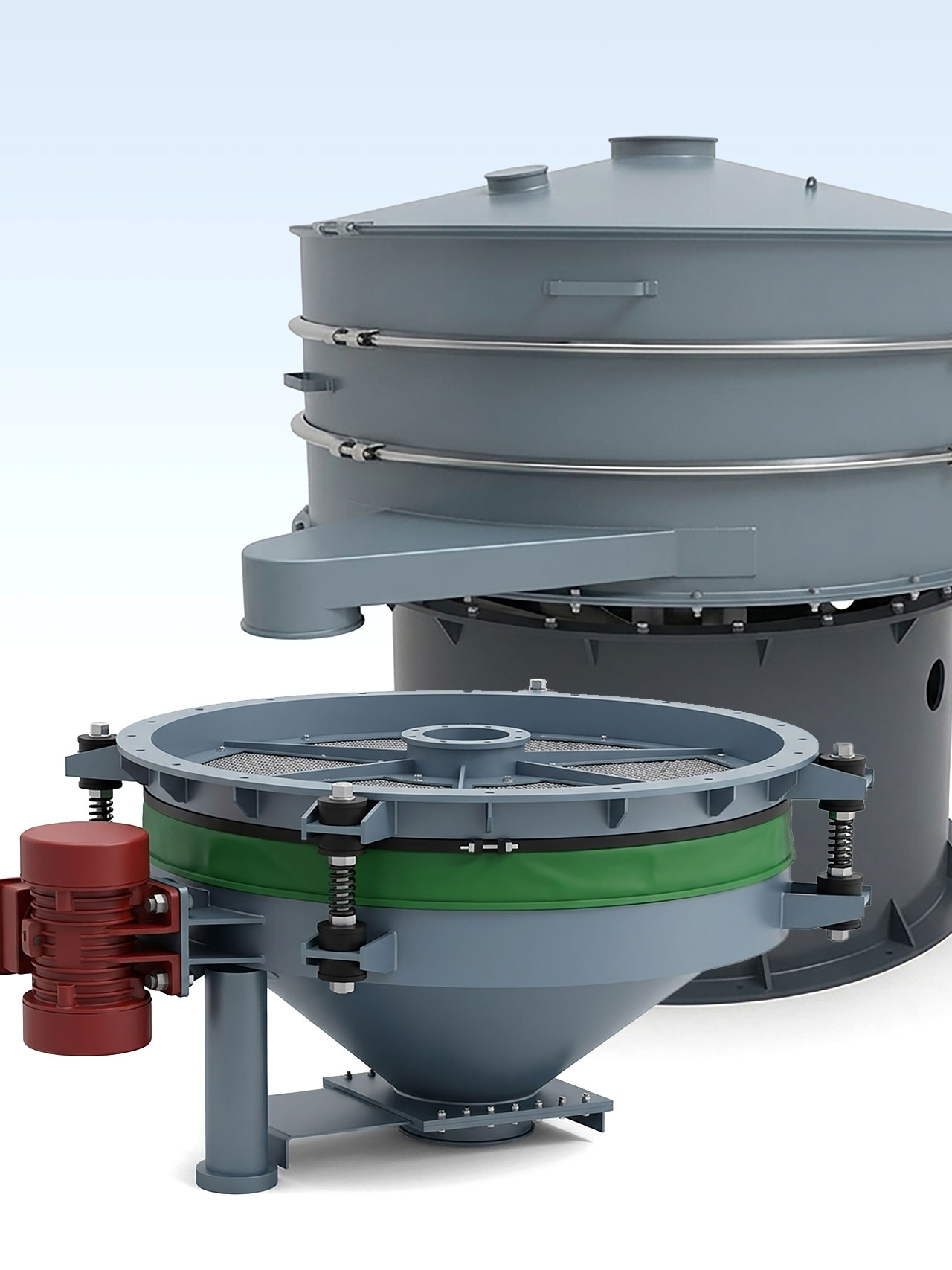
Precision Rotary Multi-Layer Sizing Screen
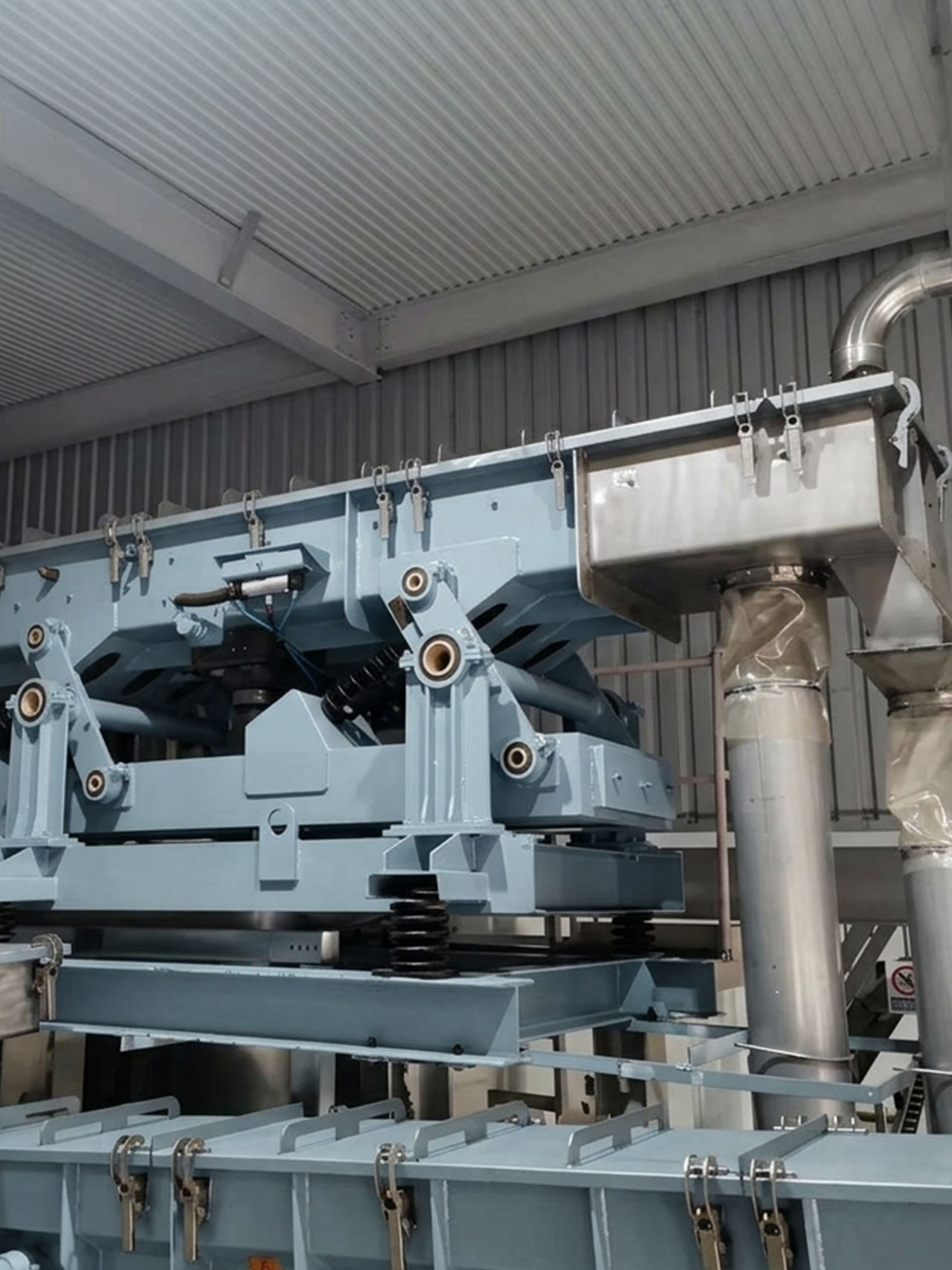
GD Type Vibrating Hopper
Incorporation of Advanced International Technology with Proprietary Design Innovations
The GD Type Vibrating Hopper is a high-tech fine classification apparatus manufactured by UHM, incorporating contemporary advanced international screening technologies and optimized through proprietary design adjustments based on complex industrial production data. Unlike planar material transport equipment designed for bulk rock and high-dust environments—such as the self-synchronizing [GZG Type Vibrating Feeder] or the heavy-duty mine-grade [ZSW Type Vibrating Sifting Feeder]—the core mission of the GD series focuses strictly on high-precision particle sizing, dry or wet impurity scalping, and high-efficiency solid-liquid separation. It integrates seamlessly into automated continuous production lines to deliver ultra-high purity multi-fraction yields.
Total Process Adaptability and Minimal Dynamic Load Transmission to Foundations
Compared to standard reciprocating vibrating screens, the GD series demonstrates far broader process adaptability. The entire assembly features a rational, compact footprint, minimal power consumption, and exceptionally low operating noise. Both the vibration intensity and the spatial movement trajectory of the material across the mesh deck can be mechanically adjusted to match specific materials. To eliminate screen blinding when handling ultra-fine powders, a specialized under-deck impact system utilizing high-elasticity bouncing balls is configured to provide continuous self-cleaning. Additionally, the final discharge direction can be freely adjusted to any angle, and because the structural assembly is isolated via premium rubber damping springs, the dynamic load transmitted to the plant foundation is practically negligible, ensuring smooth operational synergy alongside precision dosing systems like the [DMA Type Vibrating Feeder].
How Does It Work?
Standard Motor Drive via Flexible Rubber Couplings and Three-Dimensional Spatial Movement
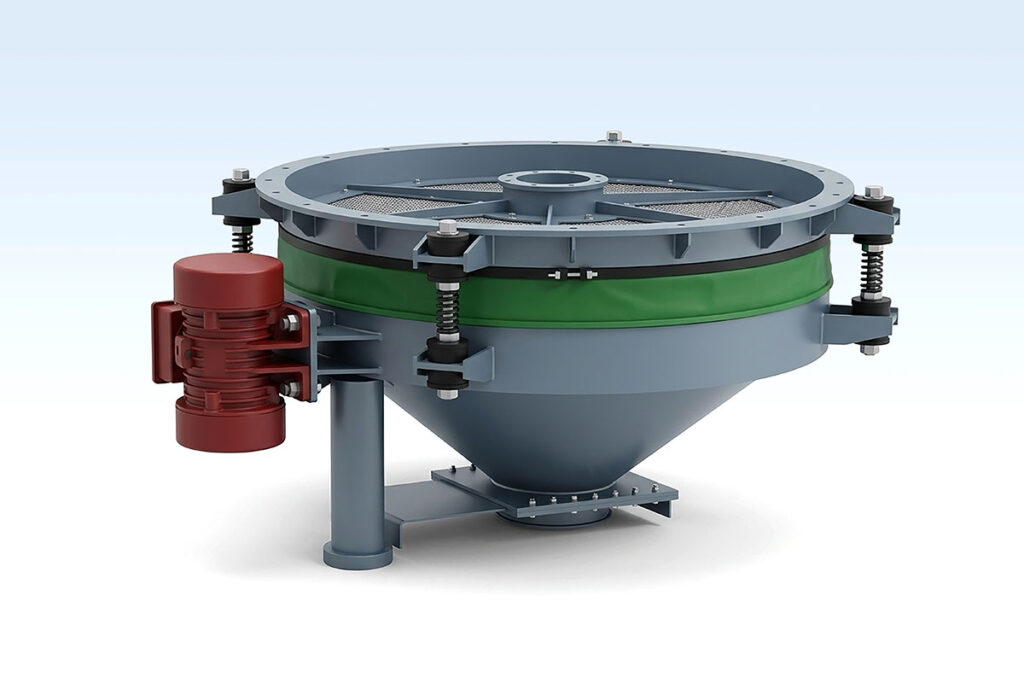
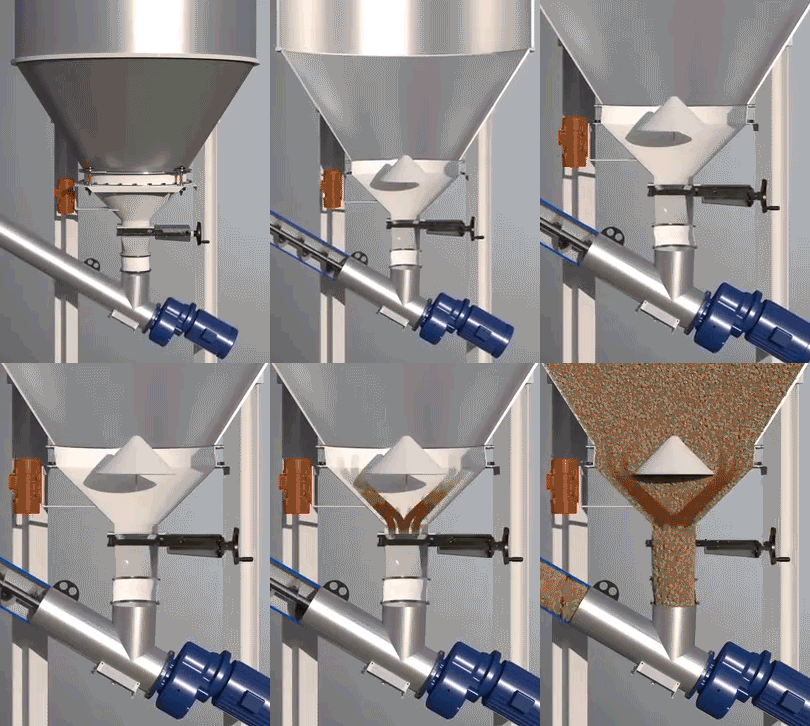
The GD Type Vibrating Hopper moves away from traditional designs that force materials across a strictly linear or flat circular path. Its driving force originates from a standard, non-vibrating electric motor mounted securely on the stationary base, which transmits power smoothly to an internal specialized exciter assembly via a high-flexibility rubber coupling. When the exciter rotates at high speeds, the top and bottom eccentric counterweights generate a three-dimensional spatial alternating excitation force due to a precisely calibrated phase angle difference. This combined force drives the entire suspended screen box into a synchronized spatial composite movement combining horizontal rotation and vertical axis oscillation, also known as three-dimensional rotary vibration.
Dynamic Shear Tumbling Action and Self-Cleaning High-Permeability Sizing
This unique multi-axis spatial trajectory creates a distinct hydrodynamic and kinetic regime for the material bed across the screen deck.
- High-Shear Tumbling: Bulk materials fed onto the center of the mesh do not immediately rush toward the discharge rim. Instead, under high-shear composite forces, they execute an inner-to-outer spiral radiating diffusion path while continuously tumbling and turning over. This path extends the actual retention and contact time of fine particles on the mesh, allowing them to rapidly migrate downward through the voids of coarse particles to pass the apertures.
- Continuous Mechanical Impact Self-Cleaning: While materials undergo multi-layer sizing, the bouncing balls trapped in the under-deck cassettes continuously jump and strike the underside of the screen cloth. This constant impact knocks loose near-size particles wedged in the apertures, maintaining maximum open-area permeability and ensuring sustained screening throughput.
What Are Its Uses?
Fine Chemicals, Papermaking, & Ceramics: High-Viscosity Slurry Filtration and Wastewater Clarification
In industrial chemical coatings, paper pulp processing, and high-density ceramic slip circuits, materials frequently exist as high-viscosity fluids or solid-laden wastewater. The GD series circular screen acts as an outstanding solid-liquid separation specialist. Its high-damping oscillating motion breaks down the surface tension of thick liquids, forcing excess water and light chemical solvents to pass rapidly through the micro-mesh while retaining undissolved agglomerates, micron-sized contaminants, or wood fibers on top for separate discharge. This self-cleaning trait secures continuous processing cycles in automated wastewater containment lines.
Pharmaceuticals, Food, & Feed Processing: Precise Multi-Stage Delumping and Quantitative Particle Grading
Food ingredients, pharmaceutical powders, micro-additives, and high-end animal feeds require strict particle uniformity and zero contamination from oversized foreign objects. A single GD circular unit can be flexibly configured with two to four layers of mesh decks, segregating a single inbound feed stream into three or four distinct, highly accurate particle sizes within a single vertical footprint. When paired upstream with a [DMA Type Vibrating Feeder] for stepless micro-flow regulation, the material fluidizes along microscopic parabolic paths, completely separating ultra-fines from coarse fractions while preventing airborne dust emissions within the cleanroom workspace.
Metallurgy, Building Materials, & Light Manufacturing: All-Weather Adaptability for Diverse Solid Densities
For dry mortar mixes, metallurgical metal powders, and abrasive mineral fines that vary significantly in weight and moisture, the GD series offers outstanding service life and maintenance convenience. The screen cloth is engineered for rapid tensioning and tool-free replacement. Whether processing high-density atomized copper powders or extremely light engineering plastic granules, operators can adjust the phase angle of the top and bottom eccentric weights within minutes to alter material retention times and vertical hop amplitudes, achieving optimal control over any dry or wet material matrix.
FAQ & VOTERS
What is the fundamental process advantage of the GD series spatial rotary trajectory compared to the linear vibration of the ZSW or GZG series feeders?
This represents the core division between heavy bulk moving and high-precision sizing. Heavy-duty drives like the [ZSW Series Heavy-Duty Grizzly Feeder] or the [GZG Series Motor Vibrating Feeder] utilize brute-force linear vibration designed to push hundreds of tons of coarse rock forward while simply dumping out loose soil. The GD Series Circular Screen, by contrast, is engineered for intricate micro-separation. Its three-dimensional spatial composite rotary motion forces fine powders or viscous liquids to spiral outward like a whirlpool while continuously tumbling. This expands the active contact area and total travel distance across the mesh, resolving the complex challenges of fine powder binding, mesh blinding, and slurry surface tension.
How are the GD series model designations defined, and what is the engineering baseline for their rated capacities?
The model number directly corresponds to the nominal diameter of the screen deck. For instance, the GD-600 features a 600mm diameter deck, while the flagship GD-1500 spans a 1.5-meter diameter. Crucially, all volumetric throughput ratings listed in our technical documentation—ranging from 1–1.5 metric tons per hour for smaller units up to 9–14 metric tons per hour for the GD-1500—are calibrated using standard river sand with a bulk density of 1.67 t/m3 under ideal laboratory conditions. When selecting a unit for your facility, if your material involves ultra-light pharmaceutical powders (bulk densities near 0.4 t/m3), high-density metallic zinc powders, or sticky wastewater streams, the capacity must be recalculated using material density and moisture correction factors rather than applying the baseline figures directly.
Is it possible to separate an inbound stream into four distinct size fractions simultaneously on a single production line using the GD series? What are the ordering requirements?
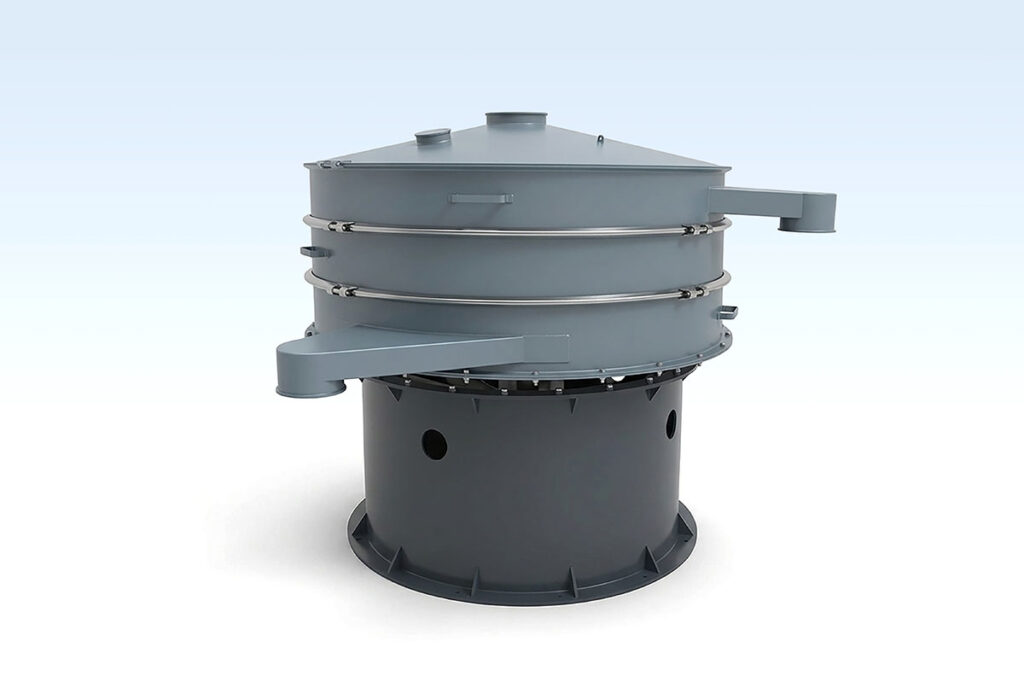
Yes, multi-fraction vertical sorting is the hallmark capability of the GD series. The system accommodates vertical modular expansion, allowing you to stack and operate two to four mesh decks simultaneously within a single footprint. The upper decks utilize larger apertures, while the lower decks feature progressively finer mesh counts, with each intermediate deck equipped with its own dedicated radial discharge spout. When submitting procurement details to our engineering department, you must specify your target model size, the number of required mesh layers, the precise mesh count or micron rating for each layer, the alloy type (such as anti-corrosive SUS304 or SUS316L), the aperture geometry (square or round hole), and any specific orientation requirements for the discharge spouts. If your process requires capacities beyond our standard GD-1500 model, our team can provide non-standard custom designs to match your specific layout.